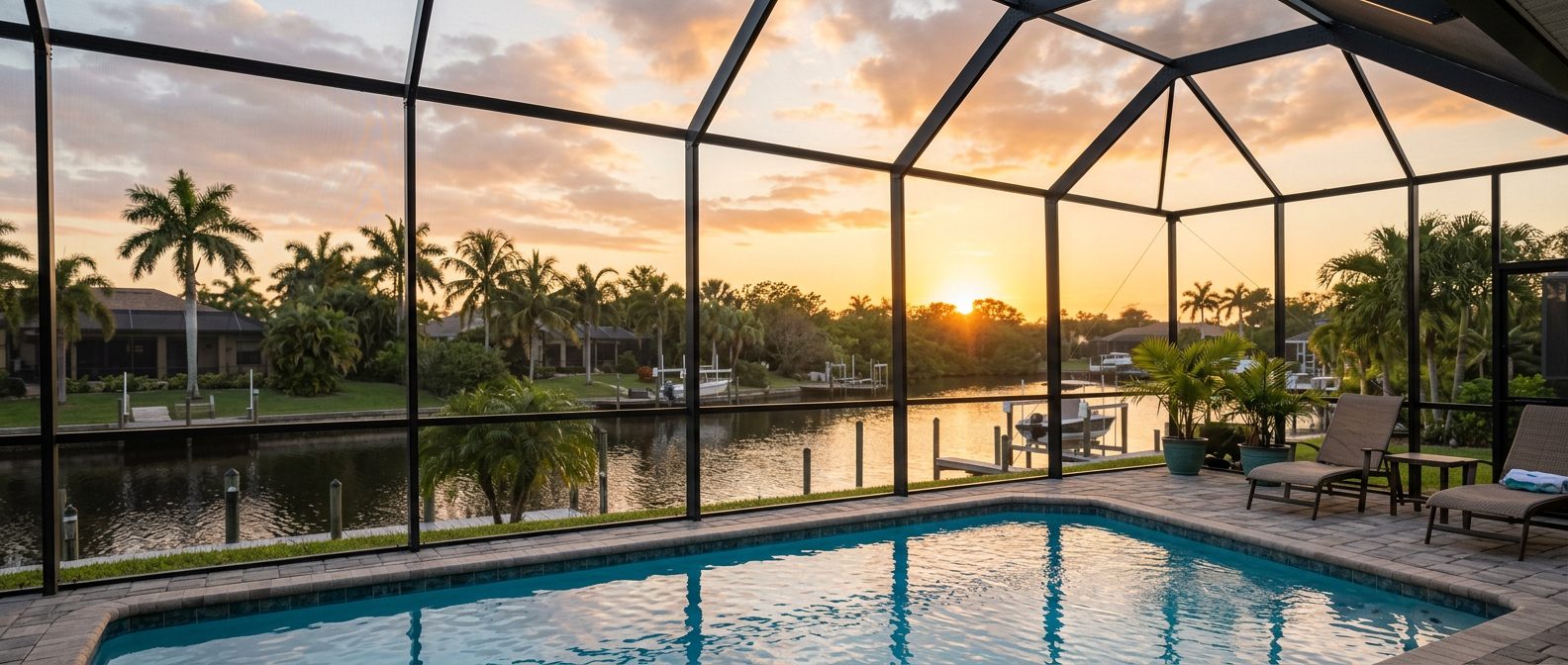
Screen enclosures in St. Petersburg. The room you get back.
Screen enclosures are engineered to a design wind speed, and the mesh, the spline, the anchors and the beam sizes are all part of that number. Most quotes in this trade say “rescreen the cage.” Ours says which mesh, which spline gauge, which anchors, and what the frame was engineered to hold.
Nothing is priced from a photograph. Somebody walks the structure first.
1The most useful line on our paperwork is usually a $0.00 one.
Ref 06 is in the hero above. The full reason, and the rest of the record it came off, are further down this page.

This is a hand-drawn illustration of a typical structure. It is not a picture of a job, because this company has never built one.
Four days from a tape measure to sitting out there again.
A cage nobody uses is a room the house has lost. This is a rescreen on a five-bay mansard, beat by beat, including the one line that was asked for and not done.
- 08:20day one
Somebody stands in front of it with a tape
Span, bay count, eave height, roof type, post and beam sizes, the condition of every splice and the state of the base anchors. On a rescreen the panels are counted and the damaged grooves noted, because a torn groove will not hold spline and has to be dealt with rather than papered over. Nothing is priced from a photograph.
- 17:40day one
The quote comes back itemised, and you can decline a line
Rescreen, kick plates, door work, base anchors and rail are priced separately, so saying no to one item is not saying no to the job. The mesh conversation has the trade-off in it: a tighter weave stops smaller insects, moves less air and presents more surface to the wind, which is physics rather than a sales caveat.
- 09:15day two
You ask for pet mesh on the roof panels and the answer is no
Pet screen is far denser than 18×14 insect mesh, and on the roof that density is extra load on a frame engineered without it — on a calm day nothing happens, in a gust the roof acts as one large surface. The dog cannot reach the roof either way. It goes on the lower wall bays below the chair rail instead, and the roof line stays on your paperwork at $0.00 with the reason written next to it.
- 07:10day four
For one hour the structure is completely naked
Old mesh cut out, spline pulled, and every groove cleaned rather than covered — twelve years of vinyl leaves residue and grit packs into the corners of the channel. It is the only time in a decade that every splice, every base anchor and every member on your cage is accessible and unclad, and anything found there is shown to you before it is screened back in.
- 16:20day four
You walk it bay by bay, and that evening you sit in it
New spline throughout, mesh tensioned evenly so each bay reads flat instead of drum-tight in one corner. Doors opened, closed and the closer set in front of you rather than photographed afterwards. Pool covered, deck swept, a magnet run for dropped fasteners, old spline and offcuts gone with us. Then the sheet: the structure as measured, the specification as built, and everything declined.
That is the whole product: a room you can use again, and a record of the structure around it — mesh, spline gauge, anchors and what the frame was engineered to hold — including the line you asked for and did not get.
What you get at the end is a record of your structure, not a receipt.
Every job leaves a sheet like this. It names the structure it was done to — the span, the bays, the roof type, the mesh, the spline gauge and the anchors — then it lists what was done and what it cost. Keep it. The next person who works on your cage should be handed it before they quote.
| Ref | Work carried out | Amount |
|---|---|---|
| 01 | Full rescreen — wall bays 1–5 and all roof panels 18×14 charcoal fiberglass. Every groove cleaned out, new .140 vinyl spline throughout. No spline reused. | $1,880.00 |
| 02 | Pet mesh — lower wall panels only, bays 2, 3 and 4, below the chair rail Heavy pet mesh set in .160 vinyl spline. Chair rail gives the change of mesh a clean line to stop at. | $310.00 |
| 03 | Kick plates renewed — 20 in., bays 2 and 3 Old plates dented at the dog’s height and no longer holding the mesh edge flat. | $240.00 |
| 04 | Screen door — corners re-keyed, hinge stile re-plumbed, closer reset Door was racking and dragging on the latch-side bottom corner. New corner keys, hinge side shimmed back to plumb, closer speed backed off so it stops slamming. | $165.00 |
| 05 | Base anchors replaced — six post bases Original anchors corroded and weeping rust into the deck. New 1/4 in. stainless wedge anchors in fresh holes; old holes filled. Anchors are not re-torqued and re-used. | $290.00 |
| 06 | Heavier pet mesh on the roof panels — declined Requested by the owner. Not carried out. Reason recorded below. | $0.00 |
Ref 06 — why we said no. Heavier pet mesh on the roof panels — declined, $0.00. Requested and not done. Pet screen is much denser than 18×14 insect mesh, and on the roof panels that density is extra load the existing frame was not engineered to carry in a storm. We fitted pet mesh on the lower wall panels where the dog actually reaches — the line above — and left the roof in standard mesh. The kick plates cost less than a bay of framing.
2Read Ref 06 again. The customer asked for pet mesh on the roof panels and paid nothing, because we did not do it.
Pet mesh on a roof is one of the easiest upsells in this trade. It is a bigger square footage than the walls, the customer has already decided they want pet mesh, and nothing goes wrong on a calm day. It goes wrong on the day the frame is asked to carry that extra density in a forty-mile-an-hour gust with the roof acting as one large surface. The dog cannot reach the roof. The mesh up there is not solving the problem it was bought to solve, and it is loading a frame that was engineered without it.
So it came off the job and $0.00 went on the sheet with the reason written next to it. That is the whole idea of the sheet.
Three things a screen quote should tell you, and mostly does not.
None of these are secrets. They are on the drawings, on the spline box and in the code book. They are left off quotes because a quote with numbers on it can be compared to another quote with numbers on it.
A cage is engineered, and the number is on the drawings.
In Florida a screen enclosure is a permitted, engineered structure built to a design wind speed taken from the code map for your address. That one figure drives everything: the beam sizes, the post sizes, the spacing of the anchors, the fastener schedule and the mesh itself.
Our quotes name it. And on a rescreen it still matters, because a rescreen has to keep the specification the frame was engineered for — you cannot quietly put a denser mesh on a frame sized for a lighter one and call it the same job.
Screen is specified, not generic. Tighter costs you breeze.
18×14 is the standard insect mesh — eighteen strands per inch one way, fourteen the other. 20×20 no-see-um is a tighter weave that stops smaller insects. Pet mesh is heavier again, woven from thicker strand to survive claws.
Here is the trade-off nobody volunteers: the tighter and heavier the weave, the less air moves through the cage and the more wind load the frame carries. Tighter mesh is not an upgrade, it is a decision — and it belongs to you, with the facts in front of you, before the price is agreed.
The cheap parts are the ones that fail.
We use .140 in. vinyl spline for 18×14 and 20×20, and .160 in. where heavier pet mesh needs a firmer bite in the groove. Spline is never reused. It has already taken its set, it has already gone brittle in the sun, and it is the least expensive material on the job.
Concrete anchors are replaced, not re-tightened. On a pool deck the anchor is what ages: water sits under the base plate, the fastener corrodes, and the concrete around it starts to spall. Re-torquing a corroded anchor in a tired hole is not a repair. New anchors go in fresh holes.
18×14 standard
Eighteen one way, fourteen the otherThe most open of the three. It stops the insects most people are trying to stop, it moves the most air, and it presents the least surface to a gust.
20×20 no-see-um
Tighter both ways, same strandSame strand, more of it. The openings close up, which is the point — and the same closing up is what takes the breeze away and hands the frame more load.
Pet screen
Coarser count, much thicker strandWoven from a far heavier strand so claws do not go through it. The strand itself is what closes the weave, so it is the densest of the three and the heaviest thing you can hang on a bay.
Read the three squares as one scale. Every step that closes the weave buys you something and charges you for it in the same move, and the frame pays the bill. That is the whole reason a mesh choice belongs to you and not to whoever is holding the quote.
Eight kinds of job, and which of them need a permit.
A rescreen is not a repair and a repair is not a rebuild. They fail differently, they price differently, and only some of them involve the building department. Here is the whole list in one table.
| Work | What it actually is | Specified as | Permit |
|---|---|---|---|
| Full rescreen | Every panel out, every groove cleaned, all new spline. The job you do once instead of chasing panels for three seasons. | 18×14 / 20×20 / pet | Permit: no |
| Panel repair | One or two panels replaced in an otherwise sound cage. Honest about the fact that a new panel looks new. | .140 vinyl spline | Permit: no |
| Storm repair | Frame first, mesh second. A blown panel with a straight frame is the system working; a bent beam is not a screen job. | Frame assessed first | Permit: sometimes |
| New enclosure | Engineered drawings, a design wind speed for your address, a permit, and beam sizes that suit the span. | Engineered, sealed | Permit: yes |
| Pool cage rebuild | When the frame, not the screen, has reached the end. Partial rebuilds, beam and post replacement, re-anchoring. | 2x5 / 2x6 SMB posts | Permit: usually |
| Screen doors | The part of a cage that gets used ten times a day and is built like the part that never moves. | Corner keys, brace, closer | Permit: no |
| Front entry screens | Entryways and porch screening — smaller spans, tighter tolerances, and it is the first thing anyone sees. | Framed to the opening | Permit: sometimes |
| Aluminum railings | Pool deck, porch and balcony rail. Load-rated, and the posts are anchored the same way the cage posts are. | Load-rated, powder coat | Permit: sometimes |
“Permit: sometimes” means it depends on what is being changed and which jurisdiction you are in. We find out before we quote, not after.
Rescreen, repair, rebuild. They are three different jobs.
A repair is panels. One or two sections of mesh have torn, the frame is sound, and the fix is to cut the old mesh out, clean the spline groove and roll new mesh in. Nothing else is touched. It is the cheapest thing we do and on a young cage it is the right answer.
A rescreen is every panel. Mesh does not fail in one place because one place got unlucky — it fails because ultraviolet light has been working on all of it for the same number of years. Once panels start going in more than one part of the structure, replacing them one at a time is buying the same job three times. On a full rescreen every groove gets cleaned out and every panel gets new spline.
A rebuild is frame. The mesh may be fine. The problem is a beam that has taken a set, a splice that has opened, a post out of plumb, or anchors that have lost the concrete around them. No amount of new screen fixes any of that, and stretching fresh mesh across a frame that is out of line is how you find out the frame is out of line.
Old cages fail at the deck, not in the middle.
Stand under a fifteen-year-old cage and everything at eye level looks acceptable. The mesh is dull, the paint is chalky, nothing is obviously wrong. Then look down at the six inches where the post meets the concrete.
That is where the structure is actually held together, and it is the worst environment on the property: pool chemistry, sprinkler overspray, standing water that wicks under the base plate and cannot dry, and a fastener sitting in the middle of it. The anchor corrodes. Rust expands. The concrete around the hole starts to spall and the anchor loses its grip long before it looks like it has.
A cage does not blow apart because the mesh gave up. It blows apart because a handful of anchors let go and the structure lost the thing that was resisting uplift. This is why our inspection starts at the deck and works up, and why replacing base anchors is a line item we suggest on old cages even when nobody asked about it.
Three of the details our quotes are written from.
These are drawn the same way we specify: the part named, the gauge named, and the reason it is on the sheet at all. Every service page carries the detail that belongs to it.
Five steps. You approve the third one before anything is ordered.
Somebody comes and measures the structure
Span, bay count, eave height, roof type, post sizes, the condition of every splice and the state of the base anchors. On a rescreen we also count panels and note which grooves are damaged, because a damaged groove will not hold spline and it has to be dealt with, not covered over.
Nothing is quoted from a photograph or over the phone.You get the mesh conversation, with the trade-off in it
18×14, 20×20 no-see-um or pet mesh, and where each of them makes sense on your particular cage. This is the conversation where we tell you what tighter mesh does to the breeze and to the load, rather than the one where we tell you the tighter one is better.
Mesh, spline gauge and color are written on the quote.The quote is itemized and you can decline any line of it
Rescreen, kick plates, door work, anchors and rail are priced separately. Approve some of it, all of it or none of it. Nothing is bundled so that saying no to one item means saying no to the job.
Declined items stay on the paperwork at $0.00 with the reason.The crew works to the specification on the quote
Two crews, both owner-supervised. Grooves cleaned, new spline, mesh tensioned evenly so the bays sit flat rather than drum-tight in one corner and slack in the other. Old spline and offcuts leave with us.
Pool covered, deck swept, magnet run for dropped fasteners.You walk it with us and you get the sheet
We go bay by bay together before anybody leaves. Then the record goes on your file: the structure, the specification, the work, the cost, and anything we recommended against.
Warranty terms are on the work order before you sign it.
Real reviews, pulled live from Google. Not a wall of quotes we typed.
On a live site this panel reads the company’s own Google Business Profile and shows what is actually there, updating itself. On this demonstration site there is nothing to read, because there is no business and there are no customers.
Tell us what the cage is doing. Somebody will come and look at it.
Torn panels, a door that drags, a frame that took a hit, or a bare deck that wants a new cage on it. The visit is how the price gets made — not the other way round.