Queue → job type
Door dings
One or two round dings from the car parked next to you. The most repairable damage a car can have, and usually gone rather than improved.
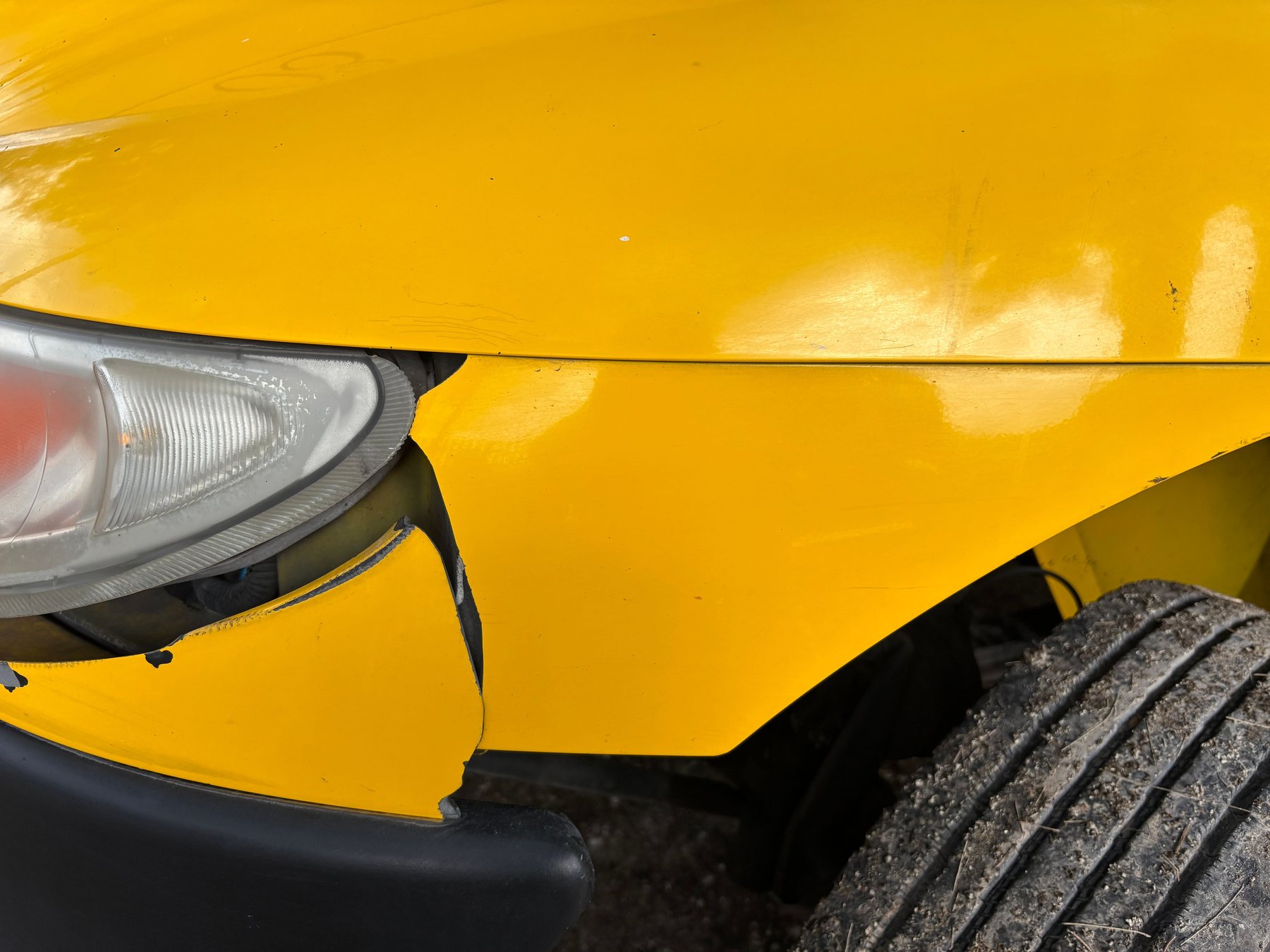
The parking lot special
Somebody opens a door into yours. It leaves a round, shallow depression somewhere between a fingernail and a golf ball, usually about waist height on the door, usually with the paint perfectly intact because a door edge has a rubber lip on it. This is the single most repairable piece of damage on a car and it is what paintless repair was invented for.
Most of them take between half an hour and an hour and a quarter, and most of them end up genuinely invisible — not “much better”, but gone, with the factory finish still on the panel.
Where it sits decides the price, not how big it is
People are always surprised by this. A two inch ding in the open flat of a door is easier than a half inch one sitting on the swage line, the sharp crease pressed into the panel that runs the length of the car. Metal in a body line has already been stretched hard by the factory press, it is under tension, and it does not want to move. The rod has less room to work, the panel wants to oil-can, and what would be a forty minute job in the flat becomes ninety minutes on the line with a more modest result.
The same goes for a ding right on the edge of a panel, or one over a brace or a reinforcement where there is no way to get a tip behind the center of it. When you send photographs, the angle shot showing where it sits on the door tells us more about the price than a close-up ever will.
Why the second one is cheap
The expensive part of a small dent is access. Getting to the back of a rear door means the interior card off, the weather barrier peeled and re-sealed, the lighting set up, the line board positioned. That is most of the labor, and once it is done the second and third ding on the same panel cost a fraction of the first.
Which is why it is worth walking around the car with a flashlight before you send the photographs. People point us at the one that annoys them and we find four more, and had they all been quoted together the total would have been noticeably less than the two separate visits it turns into otherwise.
Old dings
A ding that has been in a panel for six years is harder than one from Tuesday. The metal takes a set: it has been sitting in that shape through hundreds of heat cycles in a Florida parking lot and it has become comfortable there. It still comes out, generally, but it takes longer and it occasionally leaves the faintest memory of itself visible in a raking light. If that is what we expect, that is what the estimate says before you agree to it.
Door edge damage
The chip on the edge of your own door, from the wall of the garage, is not a dent — it is missing paint on a folded edge, and no amount of pushing brings paint back. That is a touch-up or a small refinish, and it is not ours. We will tell you that instead of quietly including it in a total.
A fingernail catches on it
Then it is not a ding, it is a chip with a dent behind it, and it goes to somebody with a spray gun. This is a thirty second test you can do yourself before you call anybody.
It is on the very edge of the panel with a brace behind it
Some positions have no route to the back of the metal at all. We will say so from the photographs rather than turning up and discovering it in your parking lot with your door card off.
It is a door edge chip, not a dent
Missing paint on a folded edge is not something pushing fixes. That is touch-up or a small refinish and it is not our work, so it does not go on our estimate.
The frame above is built at the size and shape the real picture will be, and its caption names the photograph that belongs in it. A real site carries the company's own — their vans, their techs, their panels. None have been generated for this demonstration. There is no before-and-after frame here and there is not going to be one: in this trade that pair is the result, so an invented one would be a fabricated repair rather than a placeholder.
Text photographs to (656) 236-2374 and you will have an answer the same day — a written price, or a reason it is not ours. Or use the request form. What to photograph, and why →