Queue → job type
Paintless dent repair
Metal moved back to where it started, with the factory finish never disturbed. It works while the paint is intact — and that is a rule, not a preference.
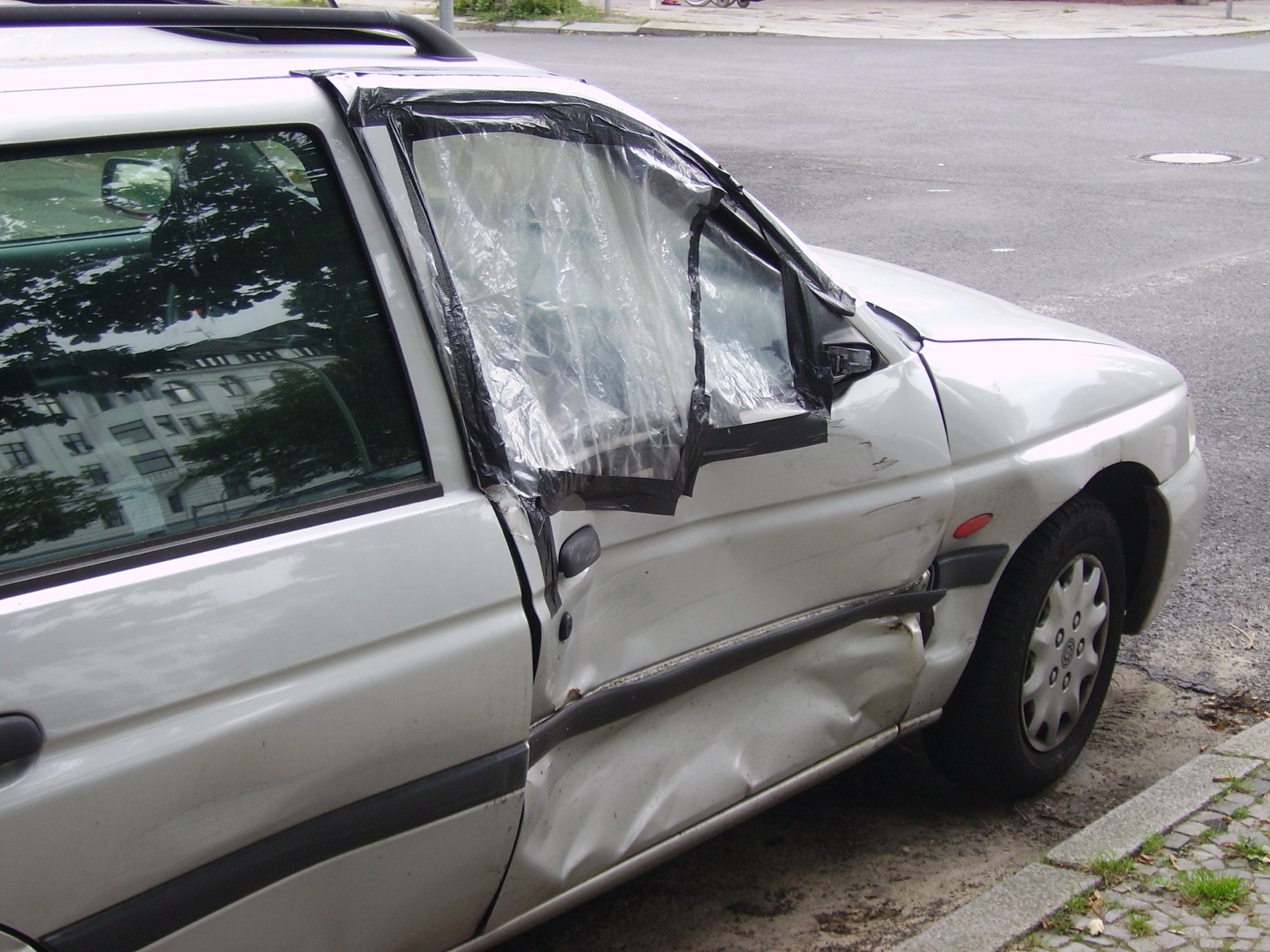
Reading it before touching it
The first ten minutes of a paintless repair involve no tools. A line board goes up beside the panel — a board of black and white stripes, or a bar of LEDs, positioned so its reflection falls across the damage — and the tech moves his head and watches what the stripe does. A straight stripe running clean across the panel means flat metal. Where the stripe pinches, kinks or doubles back there is a dent, and the exact way it distorts describes the shape of it: how deep, how wide, whether the edges are sharp, whether there is a high spot pushed up around the low.
You can feel a dent with a hand. You cannot feel any of that. And the reason it matters is that the reflection also shows what the finish is doing: a hairline crack in the clear breaks the reflected line in a way a dent never does, and that is the difference between a job we take and a job we hand to somebody else.
Working it from behind
Nearly all of it is done from the back of the panel. A rod goes in through a window channel, a tail light aperture, a factory drain hole or a gap behind trim that has been unclipped, and the tip of that rod finds the back of the dent by feel and by watching the reflection change as it moves.
Then the metal comes out in a specific order, and the order is the craft. You do not push the middle of a dent. The deepest point is the last thing to move. The outer edges of the dent are under the most tension, so those get worked first, in small pushes, walking around the perimeter and letting the whole area relax inward. Push the center first and the metal has nowhere to go: it crowns, and now there is a high spot in the panel that is considerably harder to get rid of than the original dent was.
Highs get taken down with a knockdown and a light hammer, tapping through a blending punch so the force spreads rather than punching a new mark. Done properly the panel comes back and the reflected stripe runs straight across it again with nothing to see.
Glue pulling, and when it is honest
Some panels have no way in at all. A bonded structure, a foam-filled cavity, a double skin, a brace welded across exactly the wrong place. For those, tabs are glued to the outside of the panel and drawn out with a lifter or a slide hammer, and the high spots that come with a pull are then tapped back down. It is a real technique with real skill in it — hot melt choice, tab shape, dwell time, pull force — and on a modern car it is often the only technique available.
What it should not be is a way of avoiding taking a door card off because it is late. Pulling from the face is a coarser way to move metal than pushing from behind, so where there is access, we use it.
Aluminum
Aluminum panels behave differently enough that they are effectively a separate job. Steel has memory: it wants to return toward where it was, and a good deal of the work is coaxing that tendency along. Aluminum has very little. It goes where you put it and stays there, so every push has to be right, and the panel work-hardens as you go, meaning there is a finite number of passes before the metal starts to resist entirely. Heat gets used to relax it, carefully, because too much heat on an aluminum panel is a different and much worse problem.
All of that means longer, more skill, more risk, and a higher price. A quote that treats an aluminum hood the same as a steel one is a quote from somebody who has not identified the panel.
What a good result looks like
Factory paint, untouched. No filler, nothing sanded, nothing sprayed, no color to match and nothing to fade differently in five years. The original finish is the single most valuable thing on a panel, and the entire point of paintless repair is that it survives.
The finish is cracked, chipped or touched up
This ends the conversation before it starts. Paintless repair only exists while the paint is whole; push a dent with a split clear coat and the split becomes a tear you can catch a nail on, and the panel needs refinishing that it did not need an hour earlier.
The crease is sharp and the metal is stretched
A round dent has displaced metal. A sharp crease has stretched it, and there is now more panel than there is room for. It can be worked down, but a line stays where the crease was and you will find it in a low sun for as long as you own the car. We would rather say that than take the money.
There is no way to the back of it and no honest way to make one
Bonded, braced, foamed or double-skinned panels sometimes cannot be reached without drilling an access hole or removing structure. If drilling is the only route we tell you first, including what sealing it properly involves, and quite often our advice is to leave it alone.
It has been worked on before, badly
A panel somebody has already pushed too hard, crowned, or filled has different metal to deal with than an untouched one. We will look and be honest about what is recoverable, and sometimes the answer is that the panel needed paint before we ever arrived.
The frame above is built at the size and shape the real picture will be, and its caption names the photograph that belongs in it. A real site carries the company's own — their vans, their techs, their panels. None have been generated for this demonstration. There is no before-and-after frame here and there is not going to be one: in this trade that pair is the result, so an invented one would be a fabricated repair rather than a placeholder.
Text photographs to (656) 236-2374 and you will have an answer the same day — a written price, or a reason it is not ours. Or use the request form. What to photograph, and why →