Sarasota County, and a short way over each line.
One crew means a radius rather than a map with a call center behind it. If you are outside this and the job is big enough to be worth the drive, say so and we will be honest about whether it is.
Sarasota
Home base. St. Johns riverfront live oaks and a lot of laurel oak past its span.
Bradenton
Platted subdivisions, tight rear access, cage and pool work most weeks.
Venice
Older canopy, big spreading oaks over houses that were built after them.
Nokomis
Sandhill lots, longleaf and sand live oak, and Tuskawilla’s mature street trees.
Osprey
Fast regrowth on water oak; a lot of what we do here is reduction on a cycle.
Bradenton
Acreage and pasture oaks. Open drop zones, which shows up in the price.
Nokomis
Rural, long drives, wetland edges where root plates sit in saturated soil.
Osprey
Dense mature canopy over 1970s roofs. Clearance work, mostly.
Venice
Tight lots, utility conflicts, and palms that have been hurricane-cut for years.
Lake Monroe & Midway
Riverfront wind exposure and storm callbacks.
Palmetto
Just over the county line. Sand pine and laurel oak declining together.
Palmetto
Volusia side. Large removals on small lots with no rear access.
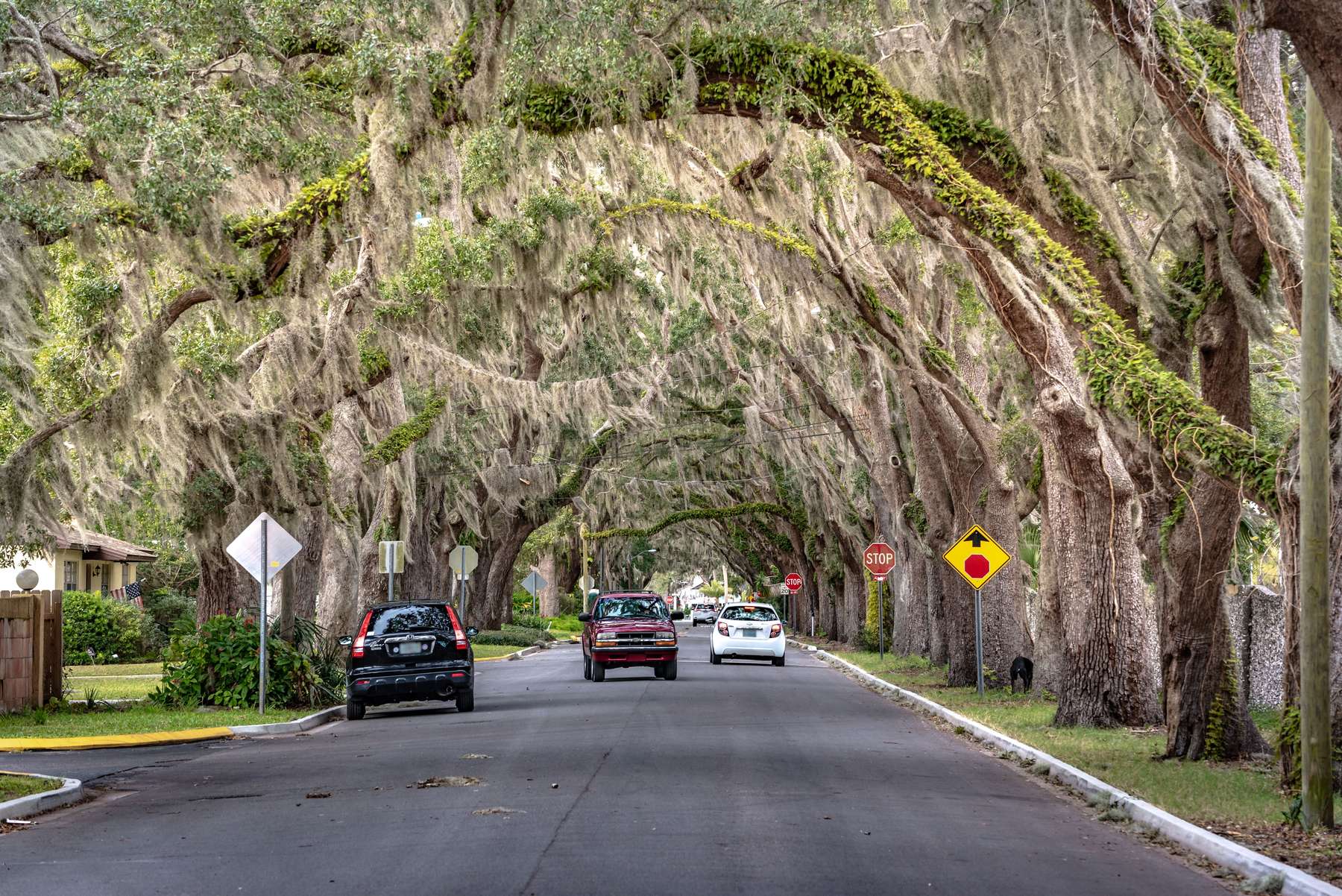
What grows here, and what it does
Southwest Florida’s canopy is dominated by a handful of species that behave very differently, and most of the arguments homeowners have with tree companies come from treating them as interchangeable.
Live oak is the one worth protecting. It is dense, strong, wind-firm when it has been left alone, and it will outlive the house. It also spreads wider than it is tall, which is why people panic about it and ask for it to be cut back hard. Almost always the correct answer is reducing end weight on two or three specific limbs.
Laurel oak looks like live oak to a homeowner and is not. It grows fast, it is brittle, and it commonly begins hollowing out from the base in its fifties or sixties. Half the removals in this county are laurel oaks that reached the end of their span at once, all through the same neighborhoods, because they were planted at the same time.
Water oak is faster and shorter-lived still, drops limbs readily, and regrows aggressively after pruning — which makes it a maintenance cycle rather than a one-off job.
Sand pine and slash pine are shallow-rooted on our sand and go over as whole trees rather than shedding limbs. A pine that has been leaning since the last storm is a different conversation from an oak doing the same thing.
Cabbage palm, the state tree, is not a tree at all in the structural sense — no cambium, no growth rings, no ability to seal a wound or grow a new leaf from the trunk. It is why the palm page on this site reads so differently from the others.
Crepe myrtle deserves a mention because of what is done to it every February. Cutting it back to knuckled stubs is topping, and the knobs are the tree’s response to repeated wounding. It flowers anyway, which is why people believe it works.
Soils and roots
Most of this area is sand with a thin organic layer, and roots run shallow and wide — typically out past the drip line, in the top foot or two. That matters for two reasons. Anything trenched, graded, or driven over inside that zone damages the tree in a way that shows up two or three years later. And a root plate in saturated soil after a week of rain holds far less than the same plate in August dust, which is why trees go over in storms that were not, by wind speed alone, especially remarkable.