A palm only has the fronds it has.
Almost everything that gets done to palms in Florida is done on the assumption that a palm is a small tree. It is not, in any structural sense, and that single fact explains why the standard treatment is so damaging.
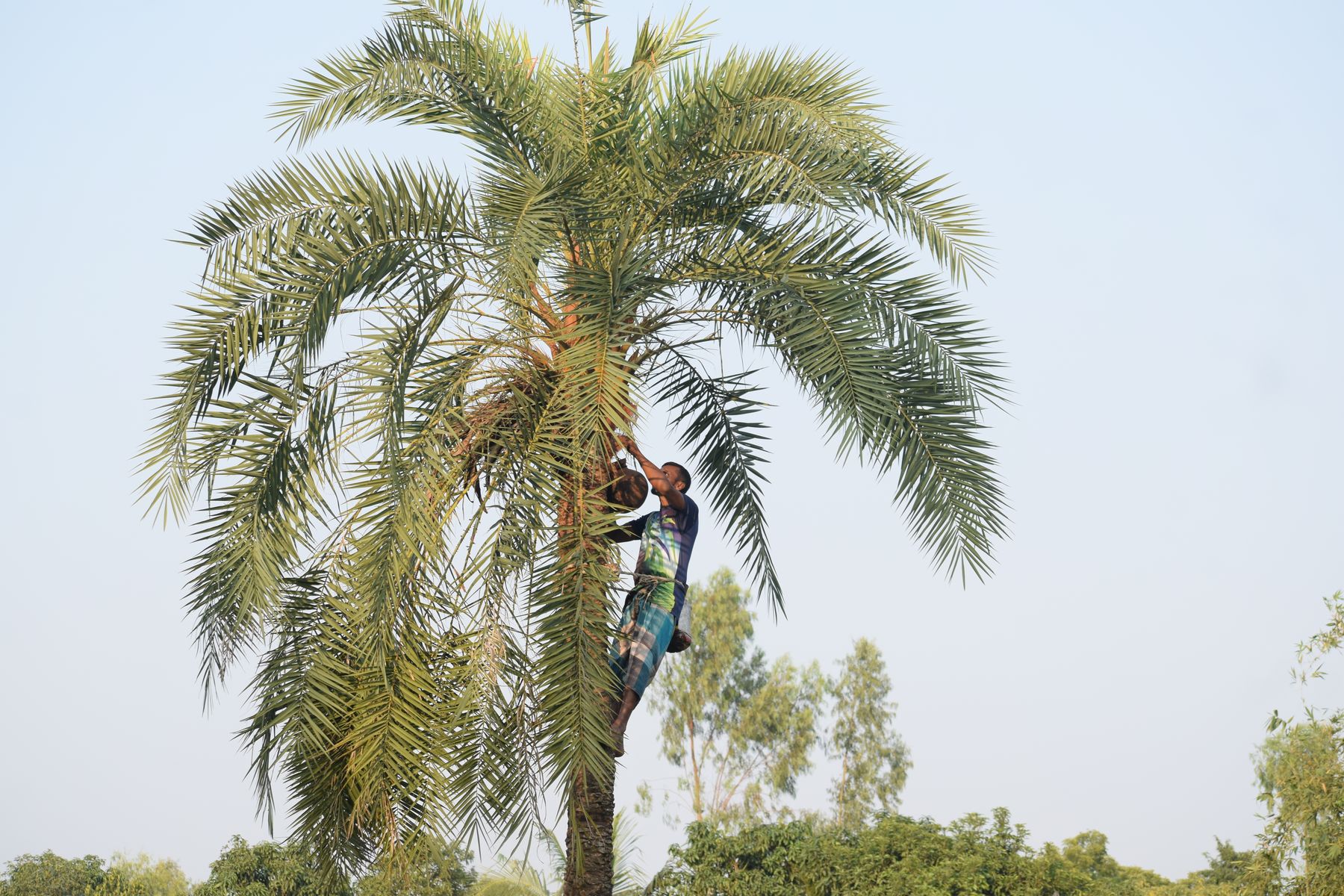
What a palm is not
A tree has a cambium: a living layer just under the bark that lays down new wood outward and new conducting tissue inward, every year, for its whole life. That is how a tree thickens, how it seals wounds, and how it grows a new branch where one was lost.
A palm has none of that. Its trunk is a bundle of vascular strands set in fiber, laid down once, at the top, and never added to. It cannot thicken. It cannot compartmentalize a wound the way a tree does. And it has exactly one growing point — a single apical meristem at the very top, the bud — from which every leaf it will ever have must emerge, one at a time.
The consequences follow directly. Damage the bud and the palm dies, with no exceptions and no recovery. Punch a hole in the trunk and it is there permanently. And any frond removed is capacity gone until the palm grows a replacement out of that one bud, at its own pace, using energy it now has less of.
The hurricane cut
Stripping a palm back to a few upright fronds — a hurricane cut, a feather duster, a nine-o’clock and three — is sold every summer as storm preparation. It does the opposite of what it promises.
- It removes the palm’s food supply at the moment it most needs reserves.
- It makes the palm weaker in wind, not stronger. The remaining fronds are the ones pointing straight up, catching wind while the drooping lower fronds that would have streamed and shed load are gone. A full canopy folds and spills wind; a spear does not.
- It leaves a narrower trunk from that point up. A stressed palm lays down a thinner section at the top, and because the trunk can never thicken again, that pinch is permanent. It is called pencil-pointing and it is a weak point for the rest of the palm’s life.
- It strips the potassium reserve. See below, because this is the one almost nobody knows.
The potassium trap
Potassium deficiency is extremely common in Florida palms, and it shows up first in the oldest fronds — translucent yellow-orange spotting, then necrotic edges, then a frizzled look, working upward over time. It looks exactly like fronds that need removing.
They do not. A palm short of potassium moves it out of its old leaves into its new ones. Those ugly old fronds are the reserve it is drawing on. Cut them off and you have removed the supply, so the deficiency moves up into younger fronds faster, which then look bad, which prompts more cutting. Palms are killed this way slowly, by tidiness.
The treatment is a controlled-release palm fertilizer with the right ratio, applied over the root zone and given a couple of years, while leaving the poor-looking fronds on the palm.
What we actually remove
- Completely dead fronds — brown throughout, hanging or fallen against the trunk.
- Flower and fruit stalks, if you want them off. On a cabbage palm this is the difference between a clean drive and a summer of berries and the wildlife that follows them. Purely your preference; the palm does not care much either way.
- Genuine hazards — a heavy dead frond boot over a walkway, a seed head over a car.
Anything with green in it stays, including fronds hanging below horizontal. The old guidance to remove everything below the nine-and-three line has been abandoned by the people who wrote it, and for good reason.
No spikes. Ever.
Climbing irons put a puncture through the trunk at every step. On a tree those wounds are walled off and grown over. On a palm they are permanent open holes into the vascular tissue, in a plant that cannot seal them, and they are a documented route for disease to enter. A palm that has been spiked repeatedly is visibly scarred for the rest of its life.
Palms are worked from a rope and saddle, a ladder where the height allows it, or a lift. If someone arrives at your cabbage palms with gaffs on, that is the whole assessment you need of the company.
Sanitizing between palms
Several serious palm diseases in Florida are spread on cutting tools. Thielaviopsis trunk rot and Fusarium wilt in particular can be moved from an infected palm to a healthy one on an unsterilized blade, and there is no cure for either once a palm has it. Tools get cleaned between palms. It costs a couple of minutes and it is not optional.
Removals
A palm is dead when the spear leaf — the newest, still-furled leaf at the center — pulls out or collapses. Nothing recovers from that, because the bud has gone. Until then, a thin, ugly, struggling palm may well be a nutrient problem that can be corrected, and it is worth finding out before it is cut down.
Cabbage palms and boots. The old leaf bases that stay attached to the trunk of a Sabal palmetto eventually shed on their own. Stripping them off deliberately to get a smooth trunk can wound the trunk if it is done before they are ready, and the trunk will never repair it. If you want a smooth column, the patient way is the only way.
Palm work, specified
| Item | Detail |
|---|---|
| Removed | Fully dead fronds, spent flower and fruit stalks, and genuine hazards over walks or drives. |
| Left on the palm | Every frond with green in it, including those below horizontal. |
| Never done | Hurricane cuts, feather-dusting, nine-and-three, or any removal of living fronds for appearance. |
| Access | Rope and saddle, ladder or lift. No climbing spikes, ever — a palm cannot seal the wounds. |
| Tools | Sanitized between palms. Several fatal palm diseases here travel on blades. |
| Yellowing oldest fronds | Usually potassium deficiency. Treat with controlled-release palm fertilizer and leave the fronds on. |
| Trunk | Cannot thicken, cannot heal. Any wound or pinch is permanent. |
| Death | Confirmed when the spear leaf collapses or pulls free. Before that, a struggling palm may be a nutrition problem. |
Figures on this page describe standard practice in the trade, not a price list. Sable Ridge Tree Care is an invented business and quotes nothing.