After the wind, work in order of what can still hurt somebody.
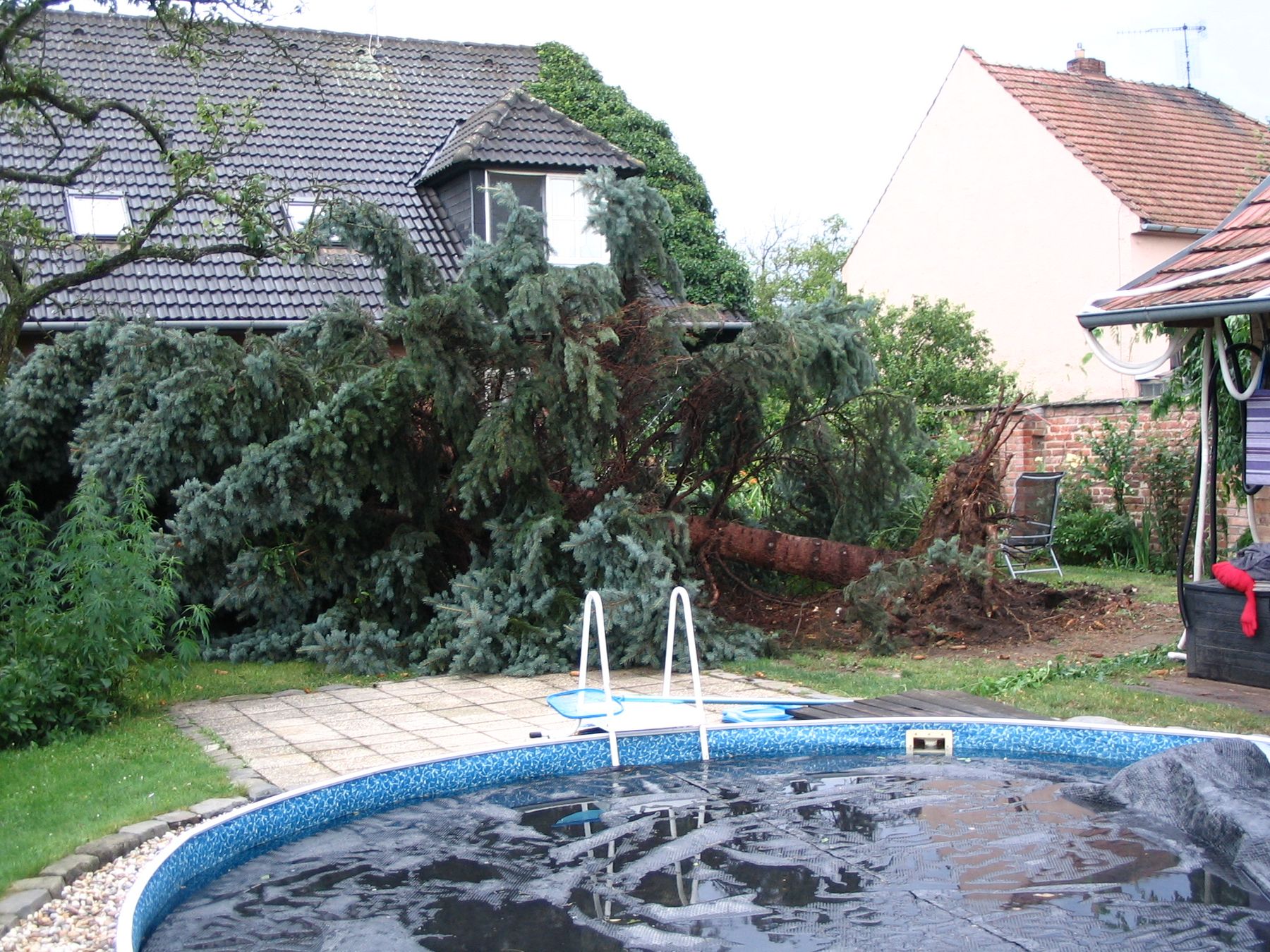
The dramatic damage and the dangerous damage are usually different trees. A trunk lying flat across an empty lawn is finished moving. A broken limb caught forty feet up in the canopy is not.
The order we work in
Storm weeks run on triage, not on a booking list, and it is worth saying so plainly because it means somebody always waits. Roughly:
- Anything on or near a conductor — not ours. That is the utility, and nobody should be under it or near it, including us.
- Hangers over occupied space. A broken limb lodged in the canopy over a bedroom, a walk or a driveway. This is the classic one that kills people, because it looks settled and it is not.
- Trunks and limbs under tension, resting on a structure or holding a load.
- Trees that have moved at the root plate, which may be standing and may be about to not be.
- Everything else, including the impressive-looking whole tree lying safely on the grass.
Hangers
A hanger is a limb that has failed but not fallen. It is held by a fork, by a strip of bark, or by the limb it landed on, and every one of those is temporary. It comes out by climbing above it and roping it out, which means the climber approaches from a position it cannot reach if it releases, and nobody stands under it while that happens.
Do not throw a rope over it from the ground and pull. That is how a fifty-pound piece arrives at head height on a trajectory nobody predicted.
Tension, and the spring pole
Storm wood is loaded wood. A bent sapling pinned under a fallen limb is a spring pole holding real energy, and cutting it in the wrong place releases all of it at once, upward, at the person holding the saw. A trunk resting on a fence is in compression on one face and tension on the other, and which is which determines the order of the cuts and whether the bar gets pinched or the log rolls.
This is the single biggest reason to leave storm cleanup to somebody who does it for a living. The chainsaw injuries after a hurricane are overwhelmingly homeowners, on the ground, on day two.
Leaning trees, and the root plate
A lean is not by itself a defect. Trees lean toward light, away from other trees, and out over water, and they build reaction wood into the lean over decades to carry it. A tree that has leaned since before you bought the house is not new information.
A tree that leaned last night is. What matters is whether the roots moved, and you assess that at the ground, not at the crown. Look on the side away from the direction of lean for soil cracked in an arc, turf lifted like a hinged mat, roots visible where they were buried, or a gap opening between the trunk and the soil on the leaning side. Any of those means the root plate has lifted and the tree is holding by less than it was.
Saturated soil is the other half. A week of rain into sand takes a great deal of holding capacity out of a root plate, which is why trees go over in storms that were not, by wind speed alone, remarkable.
Split unions
Where two codominant stems have pulled apart at the union, the crack often runs further down the trunk than the visible split. Sometimes one stem can be removed and the tree kept. Sometimes the trunk is compromised and it cannot. That is a look-at-it decision, and anyone quoting it from a photograph is guessing. Related: cabling and bracing.
On storm chasers
After a named storm, out-of-state trucks appear, knock on doors, ask for cash up front, and are gone before the trees they topped start pushing shoots. The tells are consistent: no local address, pressure to decide now, a discount for paying today, an insurance claim they offer to handle, and a recommendation to cut every tree on the property back hard “so this doesn’t happen again.”
Ask for a local address and a certificate of insurance sent to you by the insurer. That request ends most of these conversations by itself.
Insurance
Broadly, and this is not advice: policies here tend to cover removing a tree that has hit an insured structure, and tend not to cover removing one that fell in the yard. What helps a claim is documentation before anything is cut — the position of the tree, what it struck, and the date. Photographs you take yourself are worth more than anything a contractor tells you about your own policy.
Storm work, in practice
| Item | Detail |
|---|---|
| Response order | By danger, not by call order. You will be told if you are behind something more urgent. |
| Power lines | Utility work. We do not approach primary conductors and are not line-clearance qualified. |
| Hangers | Roped out from above. Never pulled from the ground. |
| Loaded wood | Assessed for tension and compression before any cut. Spring poles released deliberately. |
| Leaning trees | Assessed at the root plate first — heaved soil, lifted turf, exposed roots on the off side. |
| Before we cut | Photograph what hit what, if there is any chance of an insurance claim. |
| What we will not do | Recommend topping the surviving trees so it “doesn’t happen again.” |
Figures on this page describe standard practice in the trade, not a price list. Sable Ridge Tree Care is an invented business and quotes nothing.