04 · Flashing and boots
Caulk is not
flashing
Shingles shed water. Flashing handles every place where the shingles stop — a wall, a chimney, a valley, a pipe, a skylight. Nearly every leak in roofing is a flashing detail, and nearly every bad repair is a tube of sealant standing in for one.
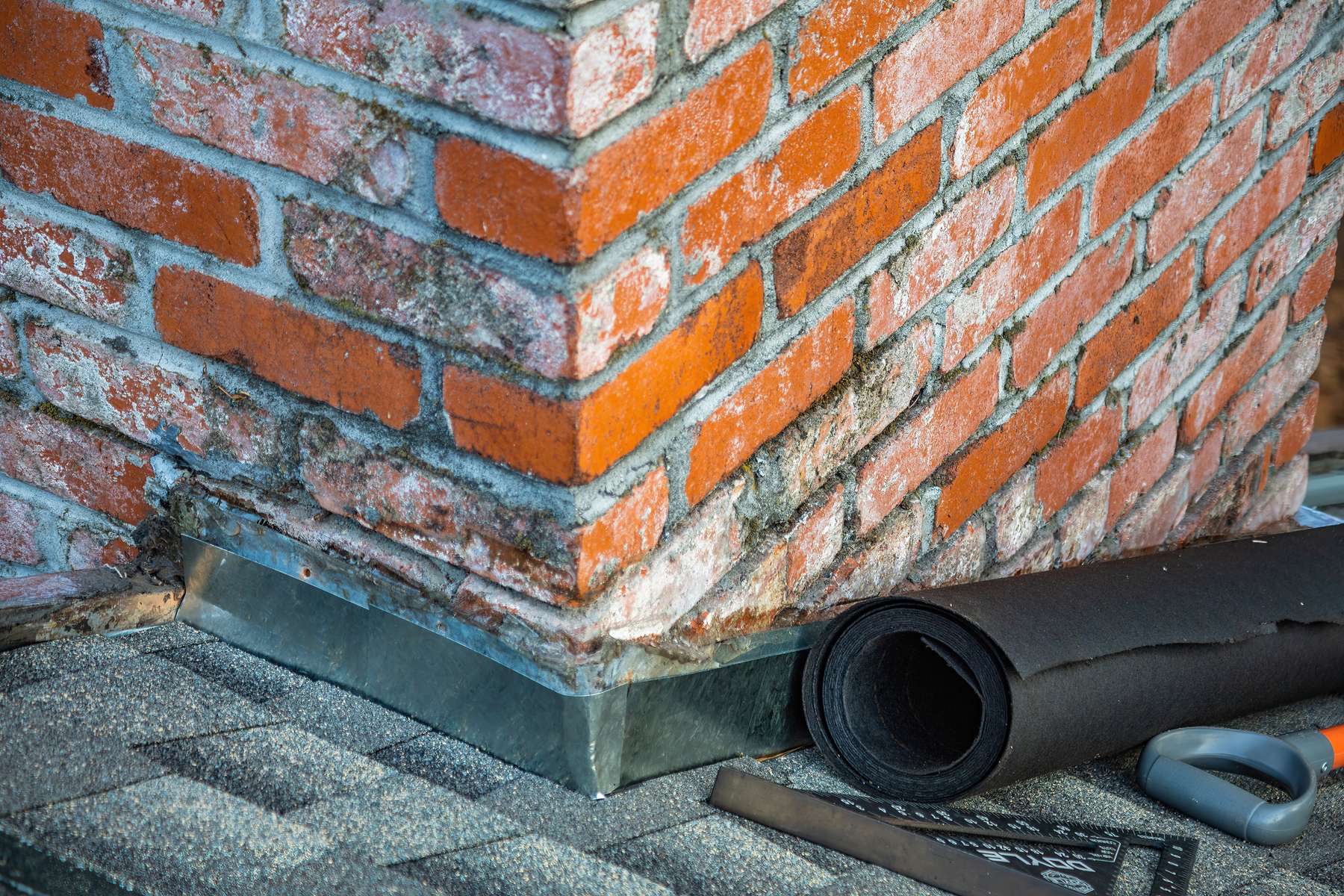
Flashing details
- Walls
- Individual step flashing, one per course, all new
- Wall base
- Kick-out fitted. Always
- Chimney
- Apron, steps, cricket over 30″ wide
- Counterflashing
- Cut into a mortar reglet, not caulked to the face
- Valleys
- Membrane + 24″ W-profile metal, open cut
- Pipe boots
- Lead, sleeve dressed into the pipe
- Skylights
- Manufacturer's flashing kit or nothing
- Sealant
- A finish, never a method
Step flashing, and the thing that replaces it badly
Where a sloping roof meets a vertical wall, the water has to be carried out over the shingles one course at a time. That means individual L-shaped pieces of metal, one per course, each lapped over the one below and each tucked under the siding or behind the counterflashing. It is slow, it is fiddly, and it is right.
The substitute you will find on a great many houses is one long bent strip of metal running the whole length of the wall, sealed to the wall with caulk. It works for about four years. Then the sealant lets go at the top edge and water runs behind the whole run at once, into the wall, where you will not see it until the sheathing is soft.
On a re-roof every piece of step flashing is new. Old flashing bent up, shingled around and bent back down has been work-hardened at exactly the crease that matters.
The kick-out, which is the piece everybody leaves off
At the bottom of a wall-to-roof intersection, the last piece of step flashing has to be kicked out away from the wall so the water it is carrying is thrown into the gutter rather than allowed to continue down the wall. Leave it off and the wall gets a concentrated stream of water at exactly one point, behind the siding, every time it rains. It is a piece of metal the size of a postcard, and its absence has destroyed more sheathing than storms have.
If you have a mysterious rot patch on a wall under a roof edge, this is why, and it is the first thing we check.
Chimneys
Four pieces, and they do different jobs. An apron on the downhill side, step flashing up both sides, and either a saddle or a cricket behind — a small false roof that splits water round the uphill face instead of letting it pond against the masonry. Anything wider than about thirty inches should have one; a wide chimney without a cricket is a dam.
Then counterflashing, which is the piece that separates careful work from quick work. It should be cut into a mortar joint — a reglet — and folded down over the step flashing, so the top edge is inside the masonry and there is no exposed seam for water to find. The quick version is a bead of sealant against the brick face. Sealant on masonry in Florida sun has a life measured in seasons.
Pipe boots
The shortest-lived thing on your roof and the cheapest to replace. A plumbing vent needs a flange sitting on the deck under the shingles above and over the shingles below, with a collar sealing round the pipe. The standard collar is neoprene and the sun cracks it in eight to twelve years while the shingles still have half their life left. We fit lead boots and dress the sleeve down inside the pipe so there is no rubber in the weather at all.
A boot that has been repaired with a rubber cap and sealant, or wrapped in tape, is a boot that will be back. Replace it.
Valleys and skylights
Valleys get membrane and 24″ W-profile metal, run open, shingles cut back and clipped. The center rib matters: it stops water sheeting across from one plane and driving up under the shingles on the other side.
Skylights get the manufacturer's flashing kit, full stop. Every skylight is designed with a specific kit of head, sill and side pieces, and a skylight bedded in sealant instead is a leak with a date on it. If the unit is old enough that no kit exists any more, the honest recommendation is a new unit, not more sealant.
Other work
The rest of what we do
- 01 Tear-off and re-roof Old roof to the deck, deck repaired and re-nailed to code, dried in, flashed and shingled. The only version of a new roof we sell.
- 02 Roof repairs A repair when a repair is honest, and a straight answer when it is money thrown at a roof with two years left in it.
- 03 Leak diagnosis Attic first, roof second, water test third. The stain on your ceiling is almost never under the hole.
- 05 Ventilation, intake and exhaust Ridge vent is the easy half. The soffit intake feeding it is the half that is usually missing.
- 06 Storm inspection What we look at after a blow, what we will document, and the two things Florida law says a roofer cannot do for you.
- 07 Gutters, fascia and drip edge Gutter apron, hanger spacing, pitch and outlet count. Most rotten fascia is a drip edge problem wearing a gutter costume.
- 08 Flat and low-slope roofing Lanais, porch roofs and additions under 2:12, where shingles do not belong and a self-adhered system does.