01 · Tear-off and re-roof
Down to the deck.
There is no other
kind of new roof here
A re-roof is six or seven separate systems that happen to be installed on the same two days: the deck, the fastening, the water barrier at the vulnerable edges, the underlayment, the metal, the shingle and the ventilation. Most of them are invisible by Wednesday.
Re-roof specification
- Old roof
- Removed to bare deck, in sections
- Deck repair
- 15/32 CDX, H-clips, priced per sheet in advance
- Deck re-nail
- 8d ring-shank, 6″ o.c., whole roof
- Eave membrane
- 36″ self-adhered
- Valleys
- Self-adhered + 24″ W-profile metal, open cut
- Underlayment
- Synthetic, capped
- Drip edge
- 8″ aluminum — under at eaves, over at rakes
- Shingle nails
- 6 per shingle, in the nailing strip, flush
- Flashing
- All new. Nothing bent back and re-used
- Ventilation
- Ridge cut and vented, intake checked and corrected
- Cleanup
- Magnet, twice, in two directions
- Not offered
- Overlay over existing shingles
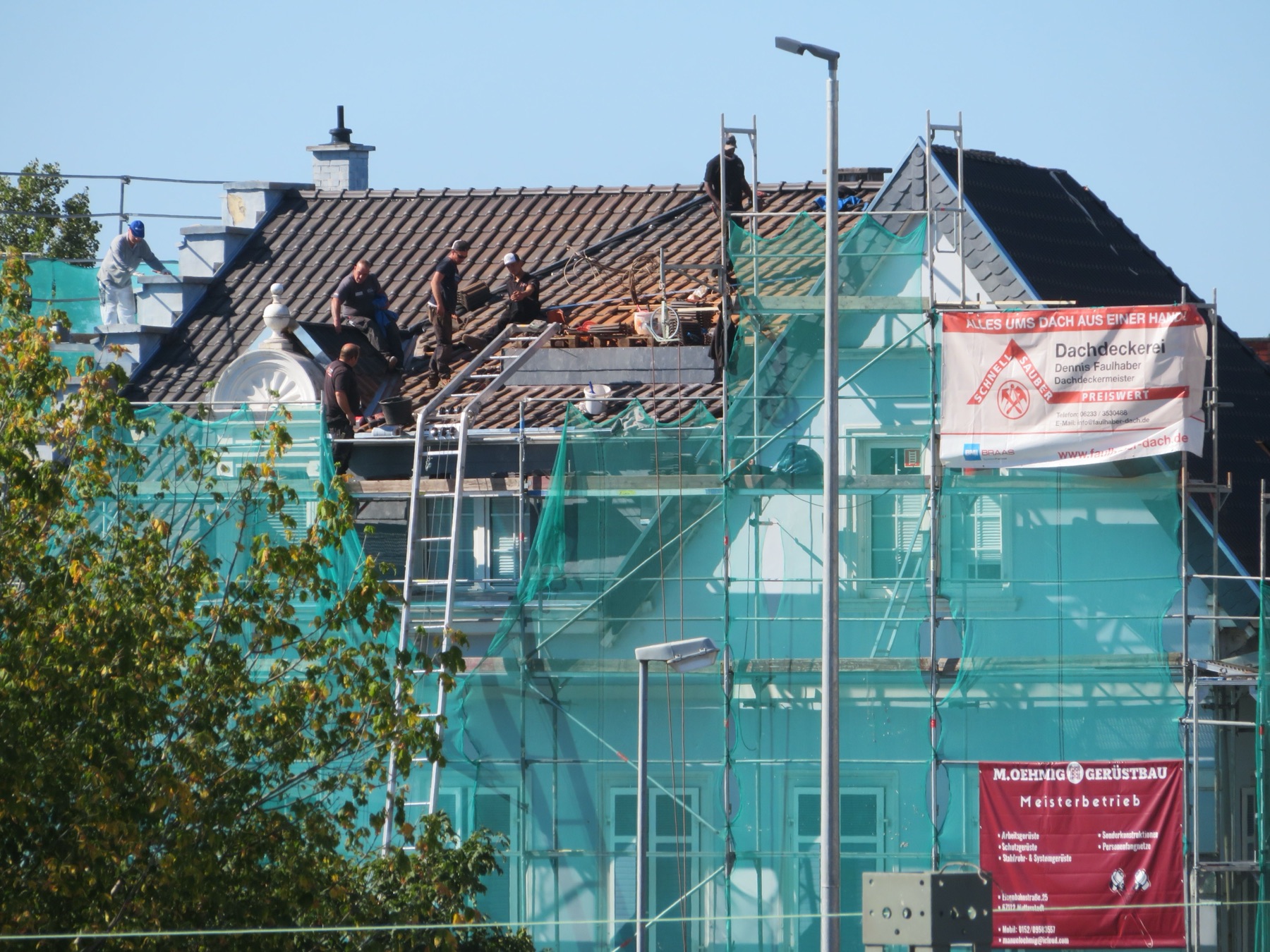
Tear-off, in sections
The old roof comes off to bare deck, and it comes off in sections rather than all at once. That is not caution for its own sake — it is so that no more of your house is open at four in the afternoon than we can dry in before the storm that arrives most summer days around four-thirty. Shovels, then a scrape for the old nails, then a broom, because a nail head left proud telegraphs through a new shingle and you will see the line from the street in a year.
Reading the deck while it is open
This is the ten minutes of the job that nobody else gets to see. Sheathing gets walked and sounded. Soft plywood, delaminated plies, black staining around a chimney or a valley, and the classic one — sheathing that is fine everywhere except a two-foot circle under an old boot — get cut out at the framing and replaced with 15/32 CDX, H-clips at the unsupported edges so the new sheet cannot ride against the old one.
You get the count while the deck is open. Not on the invoice at the end: on the day, out loud, with the sheets on the ground where you can see them. Deck is the only genuinely unknown quantity in a re-roof and it is the one every argument in this trade is about, so it is priced per sheet in the signed scope before anybody climbs a ladder.
The re-nail, which is the part the code cares about
Once the deck is sound, the whole roof is re-nailed: 8d ring-shank, 6″ on center, in the field and at the edges, into the rafters or trusses. Not just the sheets we replaced — all of it. Florida asks for this on a re-roof, and it is worth understanding why. A deck put down in the seventies or eighties was often fastened with smooth-shank nails at whatever spacing was quick, and a smooth shank in dry southern yellow pine backs out over thirty years of thermal cycling. Ring shank does not. In a serious wind the failure is rarely the shingles — it is the sheathing leaving the truss and taking everything with it.
It takes a couple of hours and it is only possible with the roof off, which is the third and best argument against an overlay.
Dry-in
Self-adhered membrane goes down first where water is most likely to sit or back up: a 36″ course along every eave, up both sides of every valley, and around chimneys and skylight curbs. Then synthetic underlayment over the field, lapped and capped, not stapled.
Drip edge is the detail people get backwards. At the eaves it goes on the deck under the underlayment, so anything that gets past the shingle runs onto the metal and out into the gutter. At the rakes it goes over the underlayment, so wind-driven water running down the rake cannot get under it. Eaves first, then underlayment, then rakes. We use 8″ aluminum, not the 2″ hemmed strip that comes on a lot of production houses and rolls in the first serious storm.
Metal, then shingle
Valleys get 24″ W-profile galvanized metal over membrane, and we run them open: the shingles are cut back about 3″ either side of the center rib and clipped, so the valley is a channel rather than a woven mat of shingle that holds grit and slows water down. Step flashing at every wall, new, on every course — not the old flashing bent back and re-used, which is what the caulk in somebody else's repair was hiding.
Then the field. Starter course at the eave and up both rakes with the sealant strip to the edge, architectural shingle, six nails per shingle in the printed nailing strip, driven flush and square. Ridge cut for vent, cap over it.
And the ground
Tarps and plywood over the beds, gutters cleaned of the granules and nails that always end up in them, and a rolling magnet twice over the drive, the paths and the lawn, in two directions. Grass hides a nail lying flat; one pass is not enough.
Other work
The rest of what we do
- 02 Roof repairs A repair when a repair is honest, and a straight answer when it is money thrown at a roof with two years left in it.
- 03 Leak diagnosis Attic first, roof second, water test third. The stain on your ceiling is almost never under the hole.
- 04 Flashing and pipe boots Step, counter, apron, kick-out, valley metal and boots. Where roofs actually leak, and where caulk pretends to be a repair.
- 05 Ventilation, intake and exhaust Ridge vent is the easy half. The soffit intake feeding it is the half that is usually missing.
- 06 Storm inspection What we look at after a blow, what we will document, and the two things Florida law says a roofer cannot do for you.
- 07 Gutters, fascia and drip edge Gutter apron, hanger spacing, pitch and outlet count. Most rotten fascia is a drip edge problem wearing a gutter costume.
- 08 Flat and low-slope roofing Lanais, porch roofs and additions under 2:12, where shingles do not belong and a self-adhered system does.