07 · Gutters and edge metal
Most rotten fascia
is a drip edge problem
in a gutter costume
The eave is a three-part detail: the drip edge, the gutter apron and the gutter itself. Get the order of those wrong and water wicks back along the underside of the roof edge into the fascia, which then gets blamed on the gutter.
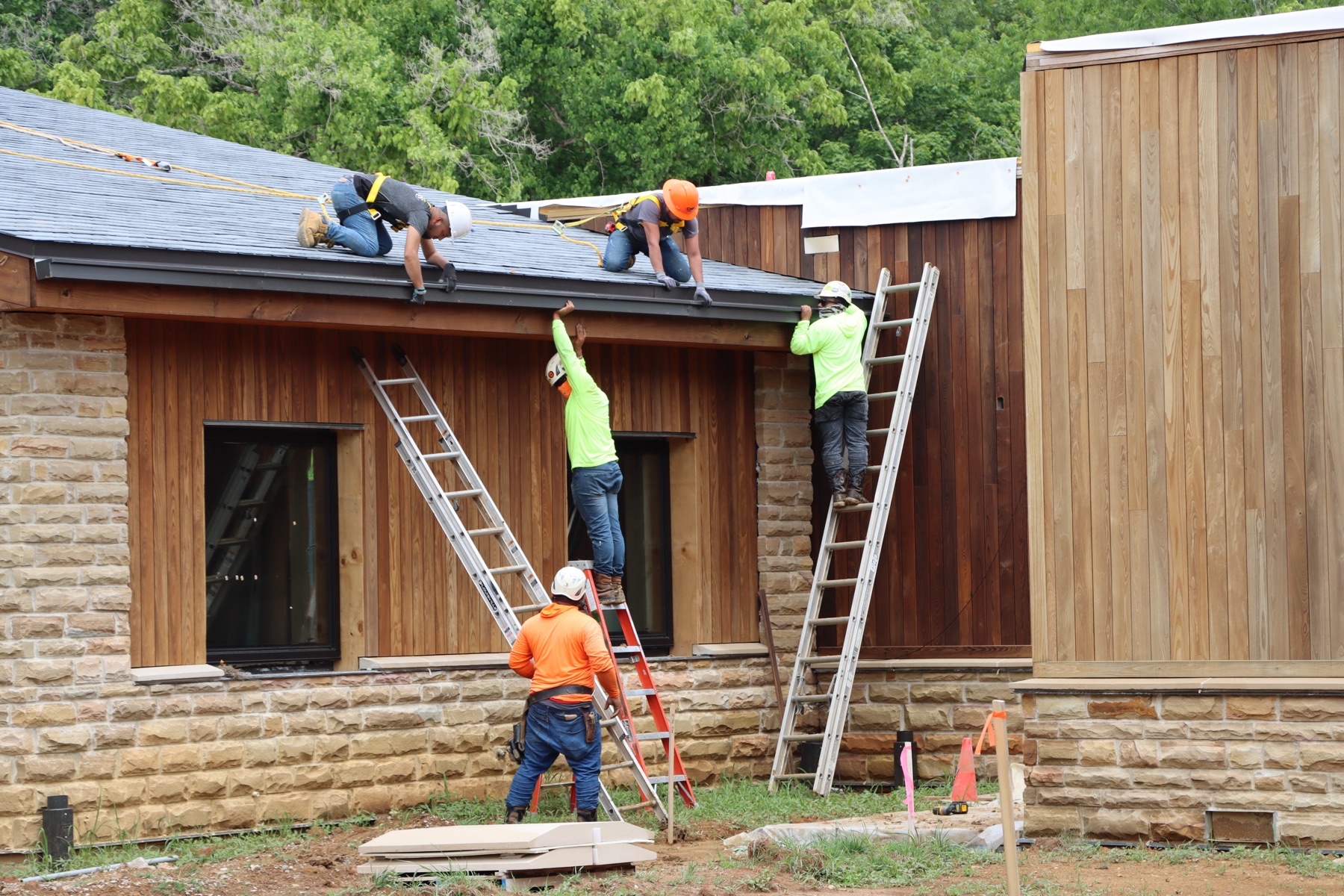
At the eave
- Edge metal
- Gutter apron over a gutter, drip edge elsewhere
- Gutter
- 5″ K-style standard, 6″ where the run demands it
- Downspout
- 3×4 where a valley or long run drains in
- Outlets
- One every 30–40 ft
- Pitch
- About ¼″ per 10 ft to the outlet
- Hangers
- Screwed, 24″ o.c. Never spikes
- Valley corners
- Splash guard fitted
- Fascia
- Soft board replaced before anything is hung
- Not our work
- Underground drainage
The gutter apron
Standard drip edge kicks water off the roof edge. That is fine over open air; over a gutter it is not enough, because surface tension will carry a thin film of water back under the metal and onto the fascia board behind the gutter. A gutter apron is a longer, deeper piece of edge metal that hangs down into the gutter, so the water is delivered rather than dropped.
This is why so much fascia rots behind a gutter that everyone agrees is working. The gutter is working. The three-quarters of an inch above it is not.
Sizing and outlets
Five-inch K-style is the default and it is undersized on a lot of Florida roofs. What matters is how much roof drains into one run and how hard it rains here. A long run off a steep plane, or a valley dumping into a single corner, wants six-inch gutter and a 3×4 downspout instead of a 2×3. The 3×4 carries something close to double, and it is the single cheapest upgrade at the eave.
An outlet every thirty to forty feet is the working rule, and any run longer than about forty feet should drain both ways from a high point in the middle rather than travel the whole length.
Pitch, hangers and the spike problem
Gutters are not level. They want roughly a quarter of an inch of fall per ten feet towards the outlet — enough to move water, little enough that the eye does not read it as crooked against a straight fascia line.
Hangers go at twenty-four inches, screwed into the fascia. Not spikes and ferrules. A spike is a nail, and a nail in a fascia board that expands and contracts every day works its way out, which is why so many older gutters have a sag with a spike head standing an inch proud next to it. Where the gutter carries a valley's worth of water, hangers go closer.
Valleys, splash and the corner nobody looks at
A valley emptying straight into a gutter over-runs it in heavy rain, and the water goes over the front lip in a sheet, straight down the wall. A splash guard on the outside of the corner is a five-dollar piece of metal that fixes it. Its absence is usually visible as a trench in the flower bed.
Fascia and soffit
If the fascia behind a gutter has gone soft, replacing the gutter alone is a waste of everybody's morning — the hangers have nothing to hold. Rotten fascia gets cut back to sound wood and replaced before anything is hung on it. And while the soffit is open, it is worth checking whether it is actually vented, because a great many perforated soffit panels are screwed over solid plywood with no holes in it. That is a ventilation problem masquerading as trim, and it is covered on the ventilation page.
Guards
We fit them when there are trees over the roof and not otherwise. A guard is not maintenance-free — fine debris still builds up on top and the good ones simply take much longer to need clearing. Anybody selling a guard as permanent is selling you the next argument.
What we do not do is underground drainage. Getting water away from the foundation is real work and it belongs to somebody who does it properly.
Other work
The rest of what we do
- 01 Tear-off and re-roof Old roof to the deck, deck repaired and re-nailed to code, dried in, flashed and shingled. The only version of a new roof we sell.
- 02 Roof repairs A repair when a repair is honest, and a straight answer when it is money thrown at a roof with two years left in it.
- 03 Leak diagnosis Attic first, roof second, water test third. The stain on your ceiling is almost never under the hole.
- 04 Flashing and pipe boots Step, counter, apron, kick-out, valley metal and boots. Where roofs actually leak, and where caulk pretends to be a repair.
- 05 Ventilation, intake and exhaust Ridge vent is the easy half. The soffit intake feeding it is the half that is usually missing.
- 06 Storm inspection What we look at after a blow, what we will document, and the two things Florida law says a roofer cannot do for you.
- 08 Flat and low-slope roofing Lanais, porch roofs and additions under 2:12, where shingles do not belong and a self-adhered system does.