AI photo estimates
Every lead answered
A customer sends photos at 2 AM. A drafted estimate is waiting for your yes at 7.
⏱ Time back
What it is
Website chat and photo leads flow in around the clock. The AI drafts a real line-item estimate from the customer's photos and their own words — every line carrying its operation, hours and rate, with repair, aftermarket and OEM priced side by side wherever the job can genuinely go more than one way. A person approves it before anything goes out. Nothing reaches a customer without a human yes.
Where this sits in the system
What reaches it
This module
⚡ The Estimator — every lead answered.
What it hands on
The Quoter · your guide here
Photos in, numbers out, a human says go. Watch me work a 2 AM lead.
the estimator · live look
Draft: door skin + blend
2 not-included ops already on the ticket
✓ Waiting for your yes — drafted while you slept.
Try it · The Estimator in 3 taps
0/3
Why it matters — the industry numbers
100×
Better odds of reaching a lead answered within 5 minutes versus 30 minutes. Odds drop 10× in the first hour alone.
MIT / InsideSales Lead Response study
Under 80s
What the industry's biggest estimating vendor now advertises for a photo-based preliminary estimate. The bar moved — customers know it.
CCC product documentation (vendor claim)
What changes when it's on staff
- ✓Leads stop dying in an unread inbox. Every one is captured with name, phone and photos.
- ✓The answer goes from days to minutes — and the shop that answers first usually wins the job.
- ✓Your counter staff stop re-typing what the customer already said; they review and press send.
- ✓After-hours stops meaning closed. The front door is open while you sleep.
- ✓A customer paying out of pocket gets a genuinely different draft — a lower labor rate, repair kept where it's safe, and cheaper part routes priced next to OEM so they can choose.
- ✓Small customer-pay jobs come back flagged as express-lane candidates, so the quick work gets spotted instead of buried behind the big files.
The moment it earns its keep
Someone gets rear-ended on a Saturday night and messages three shops from the couch. Two answer Monday. Yours answers in minutes with a real next step — and that's whose parking lot the car is in Monday morning.
On staff from the System plan
$349/mo · the whole staff, not just this module
one-time setup $2,995 — financing available at checkout, no deposit
What it actually hands you
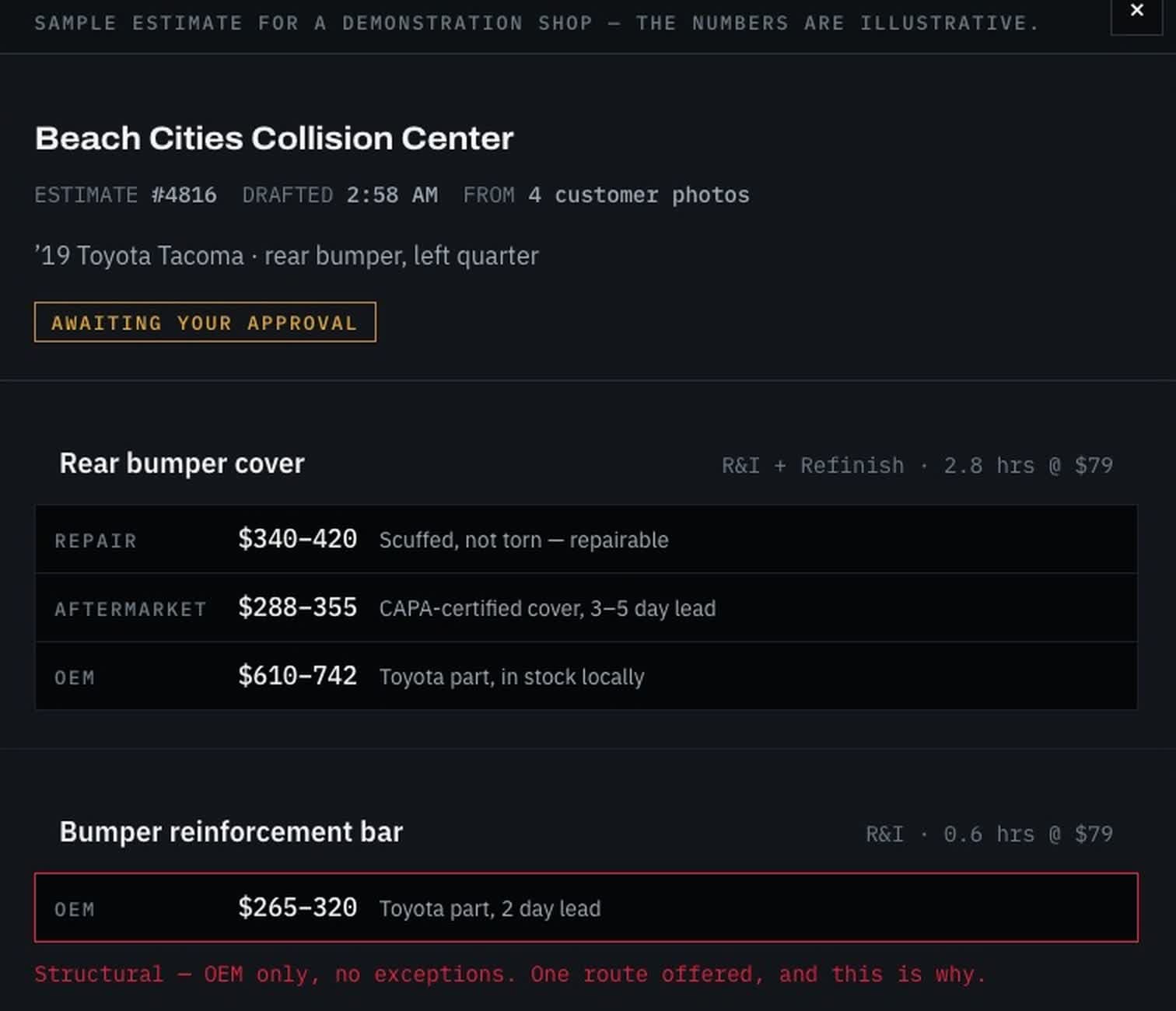
Not a damage summary somebody then types up — real line items. Every line carries the operation with its hours and rate, and where a job can genuinely go more than one way, repair, aftermarket and OEM sit side by side on the same line. Switch who's paying and watch the draft change, because it should.
Drafted from 4 customer photos · 2:47 AM
waiting for your yes
Rear bumper cover
R&I + Refinish (2.8 hrs @ $79)
- Repair$340–420Scuffed, not torn — repairable
- Aftermarket$288–355
- OEM$610–742
Bumper reinforcement bar
R&I (0.6 hrs @ $79)
- OEM$265–320Structural — OEM only, no exceptions
- no aftermarket — safety part
Rear lamp assembly, RH
R&I (0.4 hrs @ $79)
- Aftermarket$118–165
- OEM$392–455
Blend adjacent quarter panel
Refinish (1.2 hrs @ $79)
- Repair$95
Pre- and post-repair scan
Diagnostic scan (0.5 hrs @ $189)
- Repair$95
Drafted range
$861–$1,707
Customer-pay: a lower labor rate, repair kept where it is safe, and aftermarket priced beside OEM so they can choose.
⚑ express lane candidate
Illustrative draft. Parts prices are looked up live while it drafts — there is no catalog or parts feed behind it, and the numbers are a starting range for your estimator, never a quote to the customer. Nothing here reaches anyone until a person at the shop taps approve.
Change the labor rate, re-price the sheet
The hours and rate live inside the line itself, so your estimator typing your real rate re-prices every line at once instead of a page of hand math.
Aftermarket never touches a safety part
Structural and safety parts are quoted OEM only, no exceptions. On an insurance claim the whole draft is OEM — the parts profile is the carrier's call, not ours.
It looks parts prices up while it drafts
Live lookups at draft time, not a catalog we plugged into. We'd rather tell you that now than have you find it on a demo. Treat the range as a starting point for your estimator.
We don't publish an accuracy figure
We have measured it, on a sample far too small to mean anything. Quoting a percentage off six jobs would be marketing, not evidence — so we don't.
When a job can go more than one way
Repair it, replace it OEM, or replace it with a used original — the Quoter drafts every route and lets your shop pick. See the three side by side, with no recommendation.
See the three routes →Every module on this page is running in a working auto body shop today — that's playbook #1. The same bones fit any business where the owner is the whole office; your trade gets its own playbook.
Why a module like this exists · the numbers
Every module here is a job that mattered and still lost, week after week, to the cars on the floor. Customers expect it done anyway — that gap is the whole reason this system exists.
75%
of customers expect companies to use new technologies to create better experiences.
Salesforce, State of the Connected Customer, 3rd ed. (8,000+ respondents) · verified 21 August 2026
71%
of customers expect companies to communicate with them in real time.
Salesforce, State of the Connected Customer, 3rd ed. (8,000+ respondents) · verified 21 August 2026
None of that was laziness — it was arithmetic. Doing this properly used to mean a hire or an agency. That's the arithmetic that changed:
That is year one with the $2,995 setup in it; every year after is $4,188 — about 11%. Wage is the kindest comparison anyway: it leaves out payroll taxes, benefits and hiring. And we're not claiming a bot replaces a person; we're showing where the price sits. Both numbers are checkable.
Start here
See it on your own business.
Tell us the business name and a way to reach you. One of our specialists builds a short demo on your business and sends you the link — no card.