Shop floor board
The day, laid out
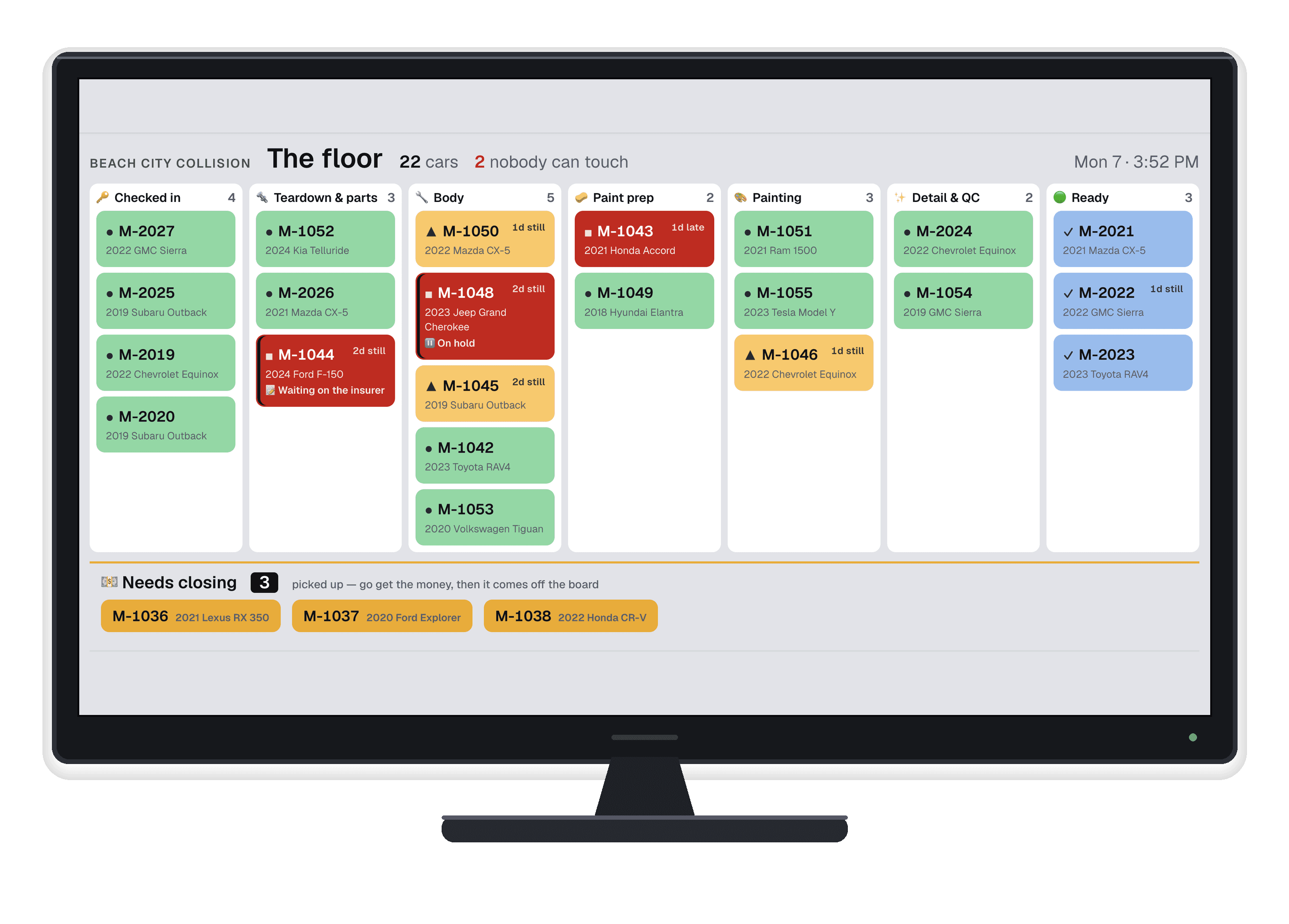
Walk in and the whole day is already on one screen.
👁 See it clearly🎛 Steer it
What it is
Every job in the building on one board — what department it's in, what status it's in, what was promised and to whom. It's a crew screen first: built for a phone held one-handed by someone wearing a glove, so techs move their own cars by tapping. It also runs on the wall as a shop-floor display, and on your computer with drag-and-drop.
Where this sits in the system
What reaches it
This module
🚗 The Floor — the day, laid out.
What it hands on
The system · your guide here
This is the screen your whole shop lives on. Ask it anything — it already knows.
the floor · live look
'18 Silverado · HD-3327
Body · promised Friday
'21 Camry · TAC-4821
Reassembly · cleared paint 9:40 AM
✓ 4:50 PM — customer called asking about the Camry. Answered in five seconds.
Try it · The Floor in 3 taps
0/3
Why it matters — the industry numbers
2.3–2.8 hrs
Actual work each car gets per day — against the 4.5 hours industry metrics assume. A 20-hour repair stretches from 4.5 days to 8.
FenderBender, touch-time analysis
15.1 days
How long your customer lives in a rental — flat year-over-year in Q2 2026, the first quarter without improvement since 2022.
Enterprise data via CollisionWeek, Aug 2026
What changes when it's on staff
- ✓The morning stops starting with "where's the Camry?" — the board answers before anyone asks.
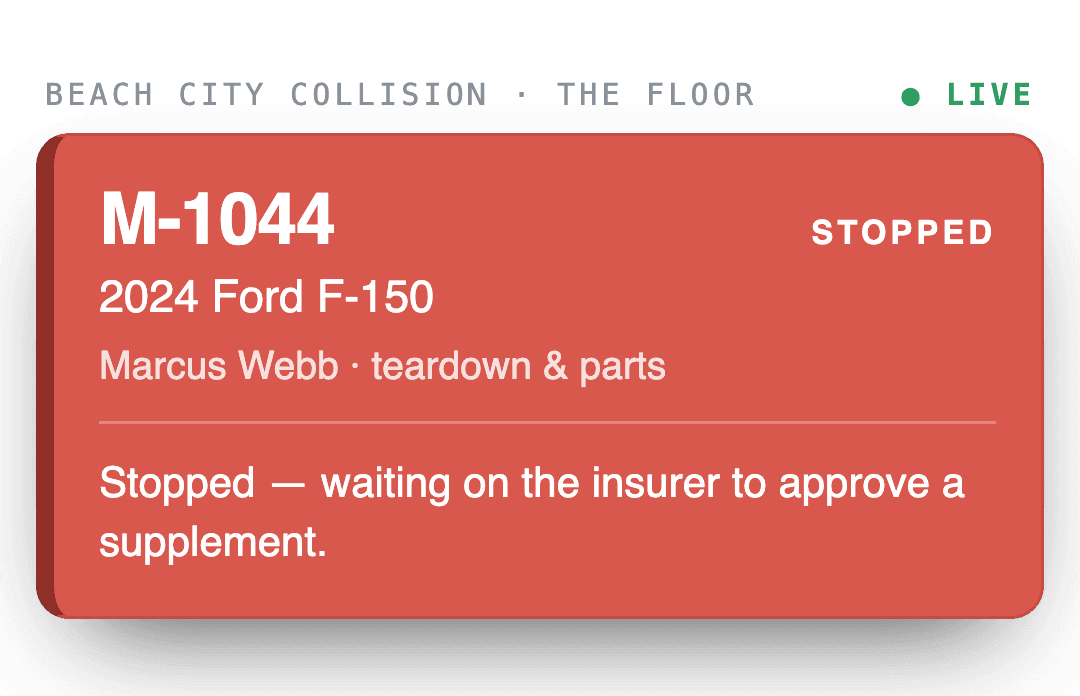
- ✓Department and status are two separate facts, so a car waiting on parts doesn't hide inside "in body."
- ✓Promise dates stop living in one person's head. Anyone can answer a customer in five seconds.
- ✓You can leave the building and still know exactly what the floor looks like.
- ✓Your crew move their own cars from their phones — one hand, wearing gloves — and the board reads in Spanish for the techs who want it that way.
- ✓A note on a job carries a color: yellow for an update, red for something you must read before you touch the car. One red beats nine yellows.
The moment it earns its keep
A customer calls at 4:50 on a Friday asking about their car. Whoever picks up taps the board, sees it cleared paint this morning and is in reassembly, and gives a real answer — no walking the shop, no "let me call you back."
On staff from the System plan
$349/mo · the whole staff, not just this module
one-time setup $2,995 — financing available at checkout, no deposit
Built for the person holding it
Most shop boards are a desktop screen someone squints at on a phone. This one went the other way — it was designed for a phone held in one hand by somebody wearing a glove, and grew up onto the wall and the desk from there.
📱
In the crew's hand
Techs move their own cars. Tap the car, tap the column — on a phone tapping isn't a fallback, it's the only thing that works, so that's what it was built around. Drag still works at a desk.
📺
On the wall
A shop-floor display mode for a big touch screen a manager can stand at, so the whole floor can see the day without anyone opening anything.
🌎
In their language
The board renders in Spanish. A crew reading “Esperando piezas” instead of “Waiting on parts” is the difference between a board they use and a board they ignore.
Two colors, and one of them wins
Anyone can leave a note on a job. Yellow means an update. Red means something you must read before you touch this car. If a job has one red note and nine yellow ones it still flies red — because the question a flag answers is “is there something I need to know first?”, and one yes is a yes.
Every module on this page is running in a working auto body shop today — that's playbook #1. The same bones fit any business where the owner is the whole office; your trade gets its own playbook.
Why a module like this exists · the numbers
Every module here is a job that mattered and still lost, week after week, to the cars on the floor. Customers expect it done anyway — that gap is the whole reason this system exists.
75%
of customers expect companies to use new technologies to create better experiences.
Salesforce, State of the Connected Customer, 3rd ed. (8,000+ respondents) · verified 21 August 2026
71%
of customers expect companies to communicate with them in real time.
Salesforce, State of the Connected Customer, 3rd ed. (8,000+ respondents) · verified 21 August 2026
None of that was laziness — it was arithmetic. Doing this properly used to mean a hire or an agency. That's the arithmetic that changed:
That is year one with the $2,995 setup in it; every year after is $4,188 — about 11%. Wage is the kindest comparison anyway: it leaves out payroll taxes, benefits and hiring. And we're not claiming a bot replaces a person; we're showing where the price sits. Both numbers are checkable.
Start here
See it on your own business.
Tell us the business name and a way to reach you. One of our specialists builds a short demo on your business and sends you the link — no card.